Hattusa
Explore Hattusa, the Hittite imperial capital: its temples, monumental gates, cuneiform archives and the rock sanctuary of Yazılıkaya.
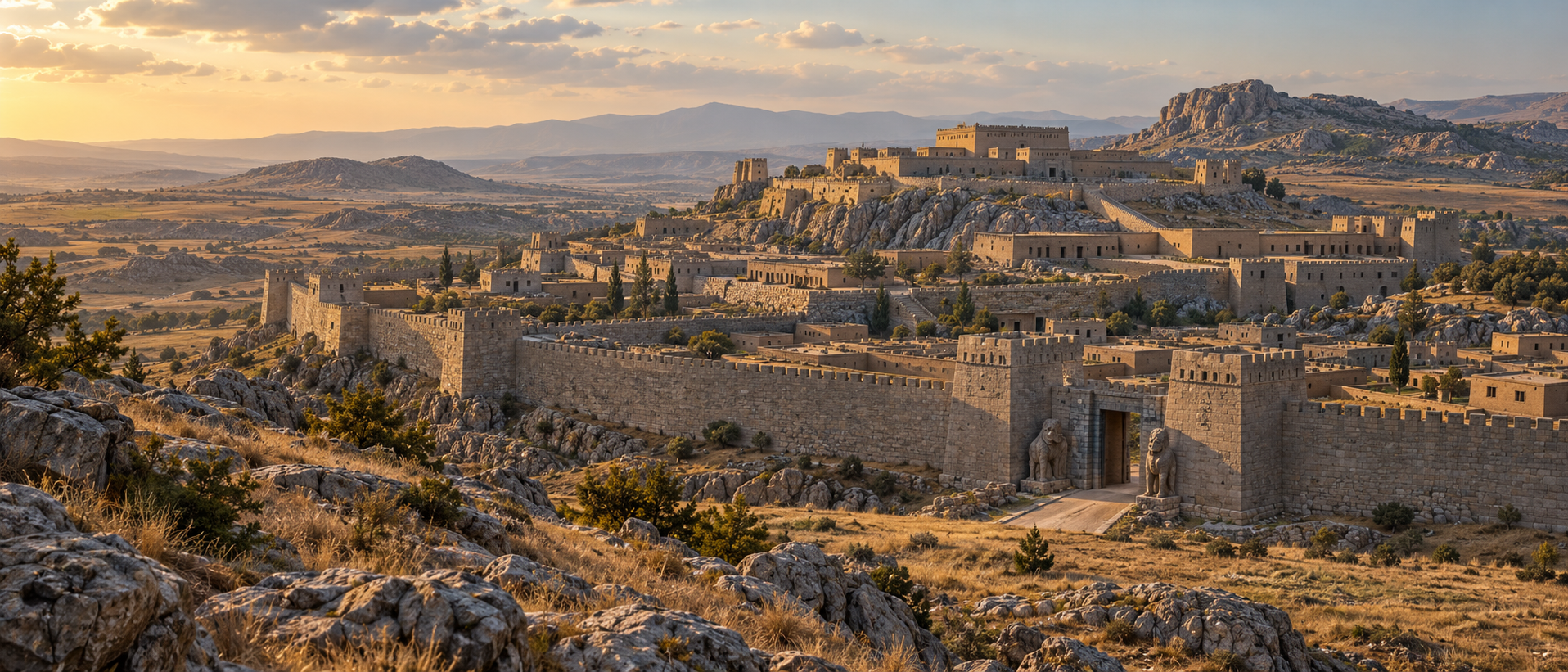
AI-generated artistic impression of Hattusa in the Late Bronze Age. This is an illustration, not a photograph or verified reconstruction.
Why Hattusa matters
Hattusa was the political and religious centre of the Hittite Empire, one of the major powers of Late Bronze Age western Asia. Its ruins occupy a broad hillside above the Budaközü plain in today’s Boğazkale district of Türkiye. A lower city, an upper city with monumental gates, and the nearby rock sanctuary of Yazılıkaya reveal the scale and organisation of the capital. The site was inscribed on the UNESCO World Heritage List in 1986.
Historical significance
People occupied parts of this landscape before the Hittite Empire. A later town called Hattush hosted an Assyrian trading colony in the nineteenth and eighteenth centuries BCE. By the mid-seventeenth century BCE Hattusa was the residence of Hittite kings. It expanded over the following centuries into an imperial capital with temples, royal buildings, fortifications and administrative archives. The city was abandoned around 1180 BCE as the Hittite Empire collapsed. Research has revised the older picture of a permanently deserted site: smaller-scale occupation continued or returned in the Iron Age, and later communities also left remains. “Hittite capital” describes its most prominent period, not the whole history of the place.
The Lower City and Great Temple
The Lower City contains residential remains and the Great Temple, the best-preserved Hittite temple ruin at Hattusa. Dating to the thirteenth century BCE, its foundations show the scale and organisation of a major religious building within the capital. The Lower City also preserves evidence of densely occupied neighbourhoods.
The Upper City and its gates
Temples occupied much of the Upper City. Its defences included the Lion’s Gate, King’s Gate and Sphinx Gate. The Sphinx Gate stood above a monumental artificial bastion, with a stone passage beneath. Some visible features have been conserved, reconstructed or represented by copies; the present appearance is not entirely untouched Bronze Age fabric.
Yazılıkaya rock sanctuary
About two kilometres northeast of the city, Yazılıkaya has two rock chambers with reliefs of deities and King Tudhaliya IV. In Chamber A, groups of male and female deities approach central divine figures. Chamber B includes the king, his protective deity and other figures; the excavation team considers a connection with funerary rites probable. Yazılıkaya is part of the World Heritage property and deserves time for its own interpretation.
The written evidence
The city’s cuneiform archives preserve records concerning government, diplomacy, religion and other aspects of Hittite life. They include a Hittite version of the treaty with Egypt associated with the aftermath of the Battle of Kadesh. The tablet collection was added to UNESCO’s Memory of the World Register in 2001. Excavation continues to change what we know: in 2023 researchers reported a ritual tablet with a passage in a previously unknown Anatolian Indo-European language associated in the text with Kalasma.
Evidence and interpretation: was Yazılıkaya also a calendar?
Established evidence: Yazılıkaya is a Hittite rock sanctuary with organised groups of carved figures. Published hypothesis: Eberhard Zangger and Rita Gautschy proposed in 2019 that the arrangement of some reliefs also served a calendrical function, tracking days, lunar months and years. The calendar reading is a scholarly interpretation, not a demonstrated account of how Hittite priests used the sanctuary.
Understanding the site today
Hattusa is a large archaeological landscape with separate areas and changes in elevation; Yazılıkaya lies outside the main city ruins. A visit can follow the relationship between the Lower City, Upper City, gates and sanctuary, while distinguishing excavated remains from restoration. Access, opening hours, mobility conditions and transport should be checked with the site operator before travel; this page does not claim those details are current.
Sources and further reading
Research references and terms are available in the Hattusa sources and glossary.