Ephesus
Explore Ephesus through its changing coastline, Roman harbour city, Library of Celsus, Terrace Houses and sanctuary of Artemis.
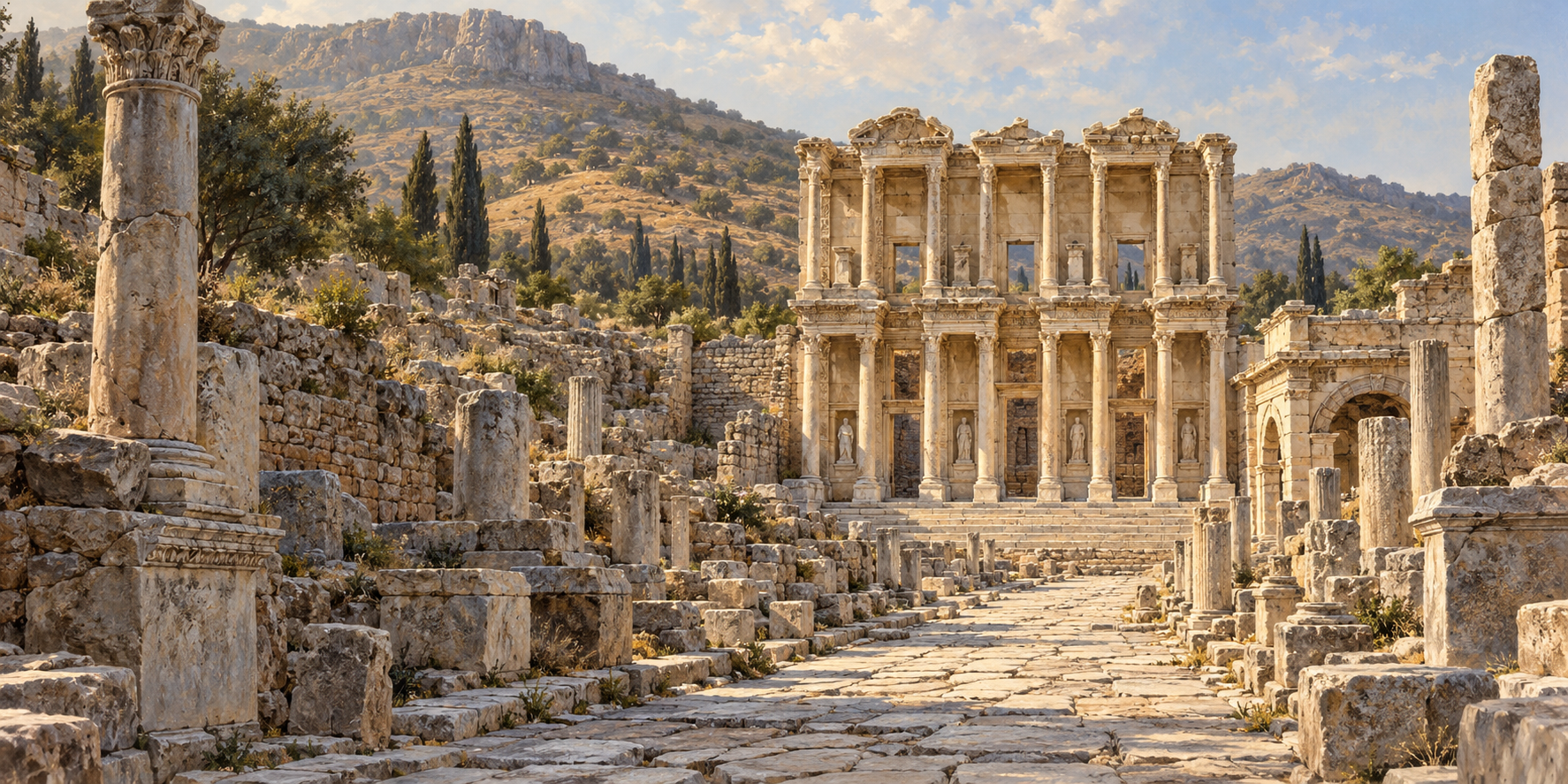
AI-generated artistic impression of the ruins of Ephesus. This is an illustration, not a photograph or documentary record.
Why Ephesus matters
Ephesus is a landscape of successive settlements near modern Selçuk in western Türkiye. The Roman city visible today developed around a harbour linked to the River Kaystros. As sediment changed the coastline, the city and its ports shifted. Its standing remains, including the Library of Celsus, Great Theatre and Terrace Houses, are only part of a longer history that includes the sanctuary of Artemis and early Christian sites. Ephesus was inscribed on the UNESCO World Heritage List in 2015.
Historical significance
Settlement in the Ephesus area reaches back well before the Roman city. The earlier phases are difficult to reconstruct because alluvium and later buildings cover many remains. A city founded under Lysimachus in the early third century BCE forms the basis of much of the visible urban plan. Under Roman rule Ephesus became a provincial centre and a major port, with a flourishing monumental core in the first and second centuries CE. It remained significant in Late Antiquity, including as a Christian pilgrimage centre. The urban area contracted over time; occupation and activity continued into medieval centuries. The idea that the city simply vanished when its harbour silted up is too simple.
The harbour and Great Theatre
The city’s Roman harbour basin connected Ephesus to eastern Mediterranean trade. Near it stood the commercial agora and the Great Theatre, which the Austrian Archaeological Institute estimates held about 22,000 spectators. The theatre served performances, public gatherings and spectacles. The harbour is no longer on the coast: sedimentation and changing shorelines reshaped the landscape over centuries.
Curetes Street and the Library of Celsus
Curetes Street linked the lower and upper parts of the city. Its irregular course reflects its earlier role as a processional route; Roman-period monuments and public fountains later lined it. The Library of Celsus was built in the early second century CE. Its famous façade was reassembled in the 1970s, so the upright monument seen today is partly a modern reconstruction. The burial chamber of Celsus lies behind the library.
Terrace Houses and everyday life
The Terrace Houses preserve a different scale of evidence from the grand public monuments. Wall paintings, mosaics and marble fittings reveal the decoration of affluent Roman homes. They illuminate domestic space, but should not be treated as a picture of how every Ephesian lived. Research into later districts also shows workshops, trade and habitation after the city's peak Roman building phase.
The Artemision and the earlier city
The sanctuary of Artemis stood beyond the core of the Roman city. Its cult gained wider importance in the Archaic period; the Lydian king Croesus supported an early monumental temple. A later fourth-century BCE building was counted among the ancient Seven Wonders. Little of that famous temple survives above ground. The sanctuary and earlier settlement areas must not be confused with the predominantly Hellenistic and Roman streets seen in the main archaeological park.
A city of changing religious traditions
Ephesus also preserves major evidence of early Christianity, including the Church of Mary and the Basilica of St John on Ayasuluk Hill. The Council of Ephesus met in 431 CE. Christian pilgrimage developed alongside changes in the urban centre during Late Antiquity. The sequence from Artemis to Christianity is a history of changing communities and practices, not proof that one ritual was simply copied from another.
Evidence and interpretation: the so-called Serapeion
Established evidence: a monumental Roman-period structure stands at the foot of Bülbüldağ. It is conventionally called the Serapeion. The Austrian Archaeological Institute states that the building's patron deity and original function remain open research questions. The name is therefore a conventional label, not proof that Serapis was worshipped there. Ongoing architectural and archaeological study may change the interpretation.
Understanding Ephesus today
The main ruins, Artemision and Ayasuluk Hill represent different phases and locations of the wider Ephesus landscape. The visible façade of the Library of Celsus includes modern reassembly. The Temple of Artemis has scant standing remains. A visitor can read the place more accurately by separating what survives, what has been reconstructed and what archaeologists infer. Opening times, route access and facilities change and should be checked with the site operator before a visit.
Sources and further reading
Research references and terms are available in the Ephesus sources and glossary.